Showing posts with label Writing. Show all posts

Monday, February 16, 2015

From Poster to POEster: Project vs. Project Based Learning with EdgarAllan Poe


Project vs. Project Based Learning

What's the Difference?

Thanks to FriEdTechnology for sharing this useful chart to break it down.
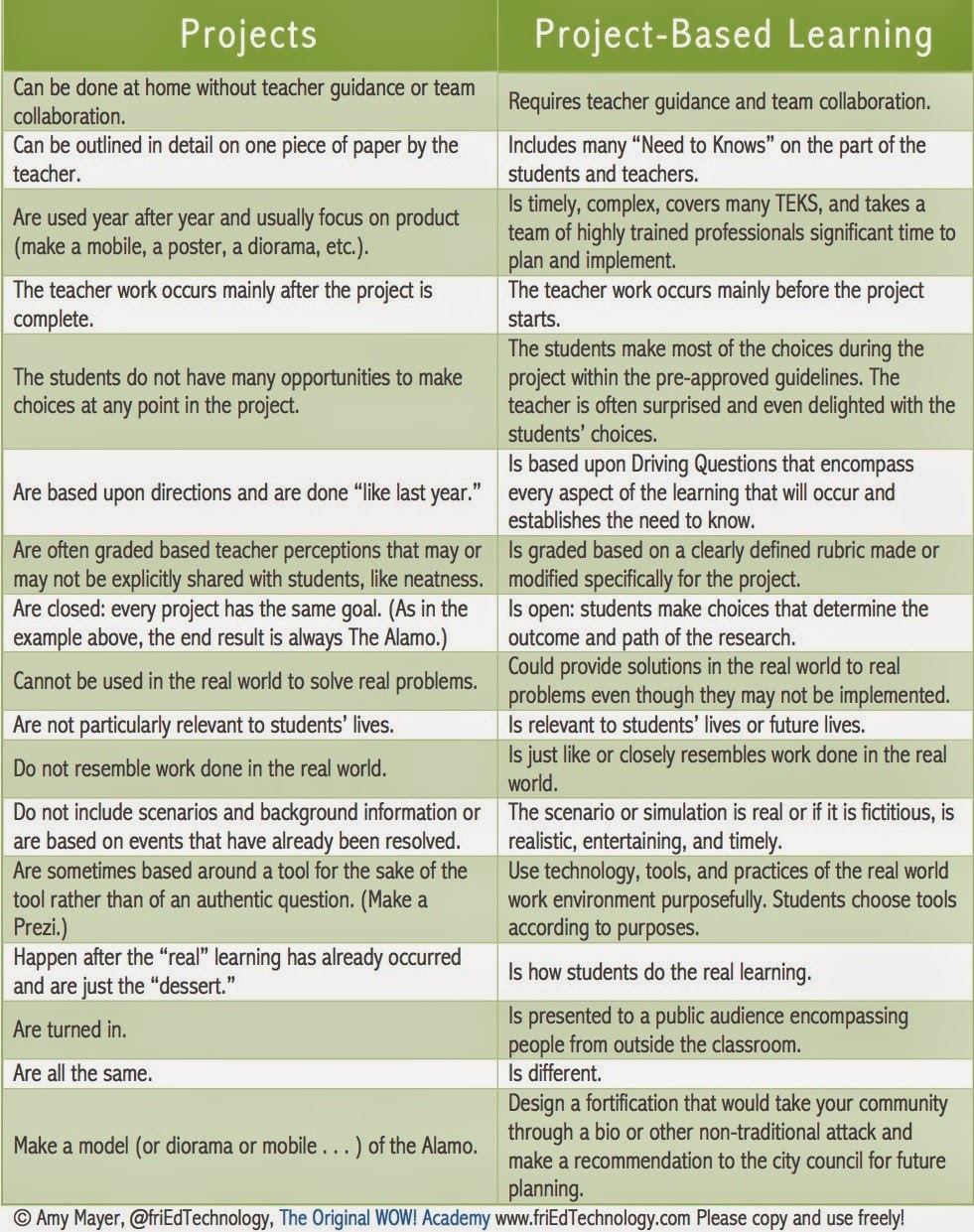
Project Based Learning in ELA:  The Edgar Allan POEsters

   My favorite lessons are the ones that I didn't plan for.  Every year, it seems, the "projects" are not the ones that I had planned and I couldn't be happier when this happens.  It means the students are driving the instruction.  
  This time we were supposed to be studying "The Raven" by Edgar Allan Poe, as part of our mystery themed unit.  We watched a documentary about Edgar Allan Poe and the students were so interested in the mysterious circumstances of his death, we got way off track with this "side project".  At first glance, you probably see posters on the wall and think project, but this is actually a really good example of project based learning in an English class.  The POEsters were necessary to present each group's top three theories to the class.  The group in the foreground of the photo could not narrow it down to three, so they have four.  
   In the interest of brevity, I am just going to give a very brief summary of four weeks of work.  I am leaving a lot out, so if you have questions please leave them in the comment section and I will elaborate.  I assigned students to a research teams to analyze the different theories and evaluate the credibility of the evidence for those theories to prioritize a list of the top three.  My initial question that I posed was which one theory do you find to be the most plausible due to the amount of supporting evidence.  The groups were really hung up on narrowing it down to one theory, even after a mini-lesson on the process of consensus decision making.  It was okay though because there was a lot of good debate going on in the groups.
   I work in a low income school district where about half of my students don't have computers, smart phones, or internet access at home, which makes researching at home an assignment I am not comfortable giving.   My access to tech in the classroom is limited as well.  I have six computers (no printer) which the students did use for additional fact checking, but I did the majority of the research for them. I printed and organized supporting documents into four clue sets.  
  1. The documentary
  2. Four articles from the internet 
  3. Primary source documents relating to Edgar Allan Poe's death
  4. Four more articles from the internet
   In their groups the evidence from the documents was analyzed, discussed, and the students were asked to come up with a hypothesis (yes we can hypothesize in English too).  Then the group would be presented with another clue set and re-evaluate their hypotheses based on the new evidence.  The process was repeated four times as each new clue set was assigned.  Then the students worked together to prioritize their list to the top three (or four in the one case) most believable theories.  They presented their theories with the evidence by making a POEster, which was then used in a gallery walk.  I teach multiple English classes, so they were critiquing many different groups' top three lists along with their evidence to support their positioning.    They were asked to describe if their thinking had changed or had the gallery walk confirmed their ideas.  They got their POEsters back and regrouped to  discuss the comments that were left on post it notes by viewers and to evaluate their work. Grades were based on exit ticket reflections and participation rubrics (one for gallery walk discussion and one for the work done in research teams) which the students filled out for themselves and their group members.  I graded the POEsters using a rubric, and since there were only about five per class, it was not a lot of work for me.  
   My top three favorite theories from the POEsters were:
  1. Rabies
  2. Cooping
  3. Brain Tumor (see the paper "The Gutter")
   I did assign the class to write their own argument essays after this "project" concluded and I am grading them this weekend.  So far, I am very happy with what I am reading.  I think all of the group work, discussions, presentations, feedback, and reflections have really helped them to write a much better paper on their own; much more so than if I had just assigned a writing prompt to begin with.

Using Anchor Charts and Interactive Student Notebooks to Improve Student Writing


Interactive Anchor Charts for the Win!

  In my first year of teaching middle school I hated grading essays.  It was so frustrating going to the next student's essay and reading "I'm going to tell you about..." over and over again despite my lessons on writing engaging leads.  When I gave the next writing prompt, following a reading of "Eleven" by Sandra Cisneros I was dreading the possibility of 60 more essays that start with "I'm going to tell you about..."   So I put up an anchor chart to remind them of some other ways that they could begin their essays, but still I got mixed results. 
Anchor Chart
 I was beyond disappointed that my anchor chart was not as successful as I had thought it would be.
Mini Anchor Chart in Notebook with Revisions of the Lead
    I copied a mini version of the anchor chart and had them put it in their Interactive Student Notebooks.  I told them all to rewrite their lead six different ways on the left side, using a different strategy from the chart each time. 
   I had taught mini-lessons on the different types of leads before the anchor chart, and again after the anchor chart-this is key.  An anchor chart alone isn't going to fix this problem.  Students have to be taught how to ask the right kind of question in their lead, otherwise they will all ask an opinion based question that the reader can answer on their own.  Instead of I'm going to tell you about my eleventh birthday you will get What do you like about birthdays?  Not much of an improvement.  After rewriting their lead six ways, I had them pair up and read each other's leads so that they could get advice on which lead made someone want to continue reading the rest of the essay.  My favorite lead was:
How can a raggedy old sweater make you feel like you are two years old again?
  Click on the link to download the writing prompt and full lesson for "Eleven" from Achieve the Core.
   We recently wrote research-based arguments on the theories surrounding the cause of Edgar Allan Poe's untimely death.  This strategy works for research papers as well as narratives. 


"I hope you liked my blog post about ..." 
   There needs to be a sequel to this post to deal with that conclusion.

Saturday, October 25, 2014

Blogging in the Classroom: Engaging Students in Discussion

What I Love About KidBlog

Contributing to our learning community in a positive way

Kidblog is available as an app on smartphones and tablets and as a webpage online, so students can access the blog at school and at home with ease.  Another great thing about kidblog is that students don't need an email account to access the blog and setting up student accounts is quick and easy.  I had my class set up their accounts in the computer lab and it took about 5 min to get everyone started.  I used the blog as a way to get students to explore online content related to our work in class and to get them engaged in learning conversations.  I posted a prompt and students were graded for participation in the discussion by responding to my prompt as well as posting comments on five posts left by classmates.

A sample blog post with a sample comment (see below):

Percy Jackson is a demi-god and the son of Poseidon.  Study the list of Greek gods and their characteristics and decide which of the Greek gods you would be a son/daughter of if you were a member of Camp Half-Blood.  Click here to go to the Camp Half-Blood web page and see a list of the gods and goddesses.  Click here to go to a page on the twelve major Greek Gods to check the facts from the Camp Half-Blood page.  Respond to this post with your name and son of, or daughter of _________ and give a brief explanation of your reasoning for your decision.
  • I would be the daughter of Athena because she is the goddess of wisdom and arts and crafts. I can be very crafty and I get pretty average grades. I like playing strategy board games too. I am very competitive like Athena, when she went up against Poseidon and when she challenged Arakhne in a weaving contest. These are some reasons why I would be a daughter of Athena.
The text that is highlighted in red contains a link that takes them to the web page that I want them to go to.  It isn't set up to work here because I just copied and pasted the text so it was readable, but on the class blog I have the links set up.

Blog Post 1

Another sample blog post with a comment:

*These are actual student responses with mistakes

Read more about Homer’s epic poems The Iliad and The Odyssey and reply to this post. Discuss:  What events do these two epic poems convey?  Why were Homer’s epic poems part of a schoolboy’s education? And finally, how did stories about heroes and heroines influence civilization?

There is also an essay about Greek Life as depicted by Homer on this page, check it out.


  • The Illiad is about the Trojan war, and the Odyssey is about a guy who was in the trojan war and then it spoke how his life was when it was over. These poems teach people about ancient civilizations.
    • I like your comment,but I wish you could have add more about how the poems have influenced civilization.
  • The Lliad is an epic poem that tells of thh war between the Greeks and the Trojans.The Odyssey tells of the adventures of a hero and the Greeks on their return home from Troy.The school boys learned these poems because they tell of heroes in the community.The poems could have influenced important people in history to commit acts that have changed civilization.

Sample Blog Post 2
I did a lot of coaching on how to speak in a scholarly way when posting and commenting on others posts.
My Mini-Computer Lab
Here is a better photo of the anchor chart posted in my in class computer station as a reminder of proper etiquette when posting on the blog.
Blogging Checklist Anchor Chart
This is a great way to get students engaging in discussions about learning topics and/or text and there are so many ways that it can be used.  I'd love to hear about how you use blogging in the classroom.